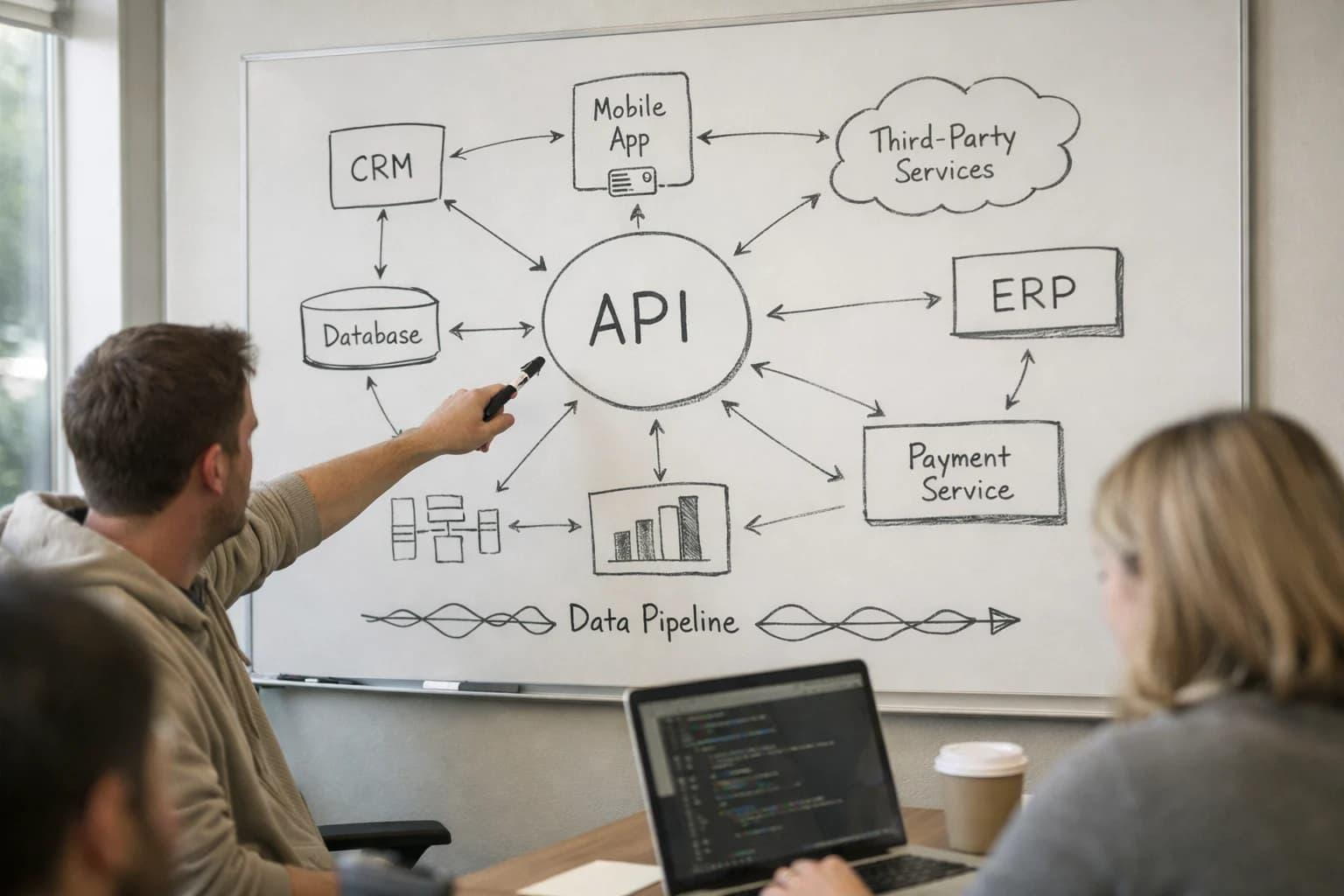
Third-party glue,
engineered with rigour.
Vendor and partner integrations engineered with contracts, resilience, security and observability, because the systems you don't control still get to break your product.
The third-party you integrated with once is the third-party you'll debug for years. The systems that stay reliable are the ones designed to survive their vendors' bad days.
Design defensively
Circuit-breakers, timeouts, retries and fallbacks on every dependency, because vendors have bad days too.
We build assuming the third-party will fail intermittently, deprecate without notice, and change semantics quietly. Circuit-breakers, retries and fallbacks are first-class.
The integration that stays reliable is the one designed for their worst day, not their best.
The third-party you integrated with once is the third-party you'll debug for years.
Contract & test
Contract tests in CI, staging against sandboxes and production against real. Regressions caught before deploy.
Every call has a schema. Every response is validated. Regressions caught by tests, not by users.
Sandboxes are used for capability, production traffic for reality.
Observe & alert
Latency, error and rate metrics per vendor. Alerts tuned so vendor incidents surface immediately.
Per-vendor dashboards, honest SLAs, escalation paths documented. When a vendor is degraded, we know before support tickets pile up.
Vendor incidents are engineered against, not endured.
Govern & rationalise
Portfolio view of every vendor dependency, cost, criticality, contract terms and replacement plan.
Vendors are risk-tiered on impact. Higher-tier vendors get structured onboarding and continuous assurance. Redundant vendors get rationalised.
The vendor portfolio compounds instead of accumulating.
Toolkit
Framework, platform and vendor selection is driven by the shape of the work and the team who'll own it, not by whichever ecosystem is loudest this year. The list below is representative, not prescriptive.
- iPaaS
- Workato · Boomi · MuleSoft · n8n
- Payments
- Stripe · Adyen · PayPal
- Comms
- Twilio · SendGrid · Slack
- Identity
- Auth0 · Okta · Ping
- Observability
- OpenTelemetry · Datadog · Grafana
Selected work
What clients ask us first
01How do you design for vendor outages?
Circuit-breakers, timeouts, retries with backoff, fallback behaviour and honest UX when a dependency is degraded. The integration is designed for the vendor's bad day, not their best.
02How do you handle vendor deprecations?
Contract tests catch schema drift. Versioning policies negotiated where possible. Portfolio view keeps us aware of dependencies before they become surprises.
03How do you approach vendor security review?
Risk-tiered on impact. Higher-tier vendors get structured onboarding, continuous assurance and contractual controls. SBOM and provenance where the software supply chain matters.
04How do you decide when to replace a vendor?
By evidence, cost, reliability, capability gap, or a redundant alternative. The vendor portfolio is a living document, not a permanent decision.

Let's discuss your vendor integration.
Share a brief overview of the vendors and dependencies, we'll arrange an introductory conversation with the relevant practice leadership.