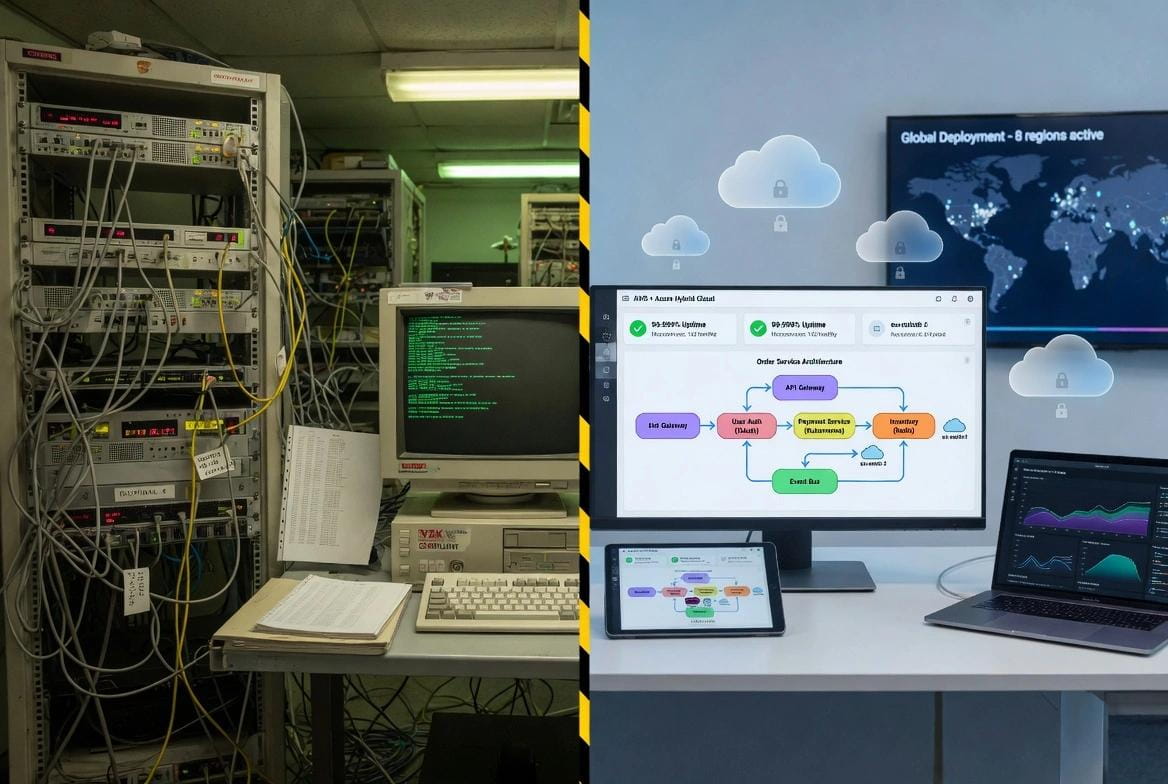
Migration,
as rolling, reversible waves.
Legacy modernisation and cloud migration engineered against reality, application, data, database, mainframe and cross-cloud, with reconciliation designed in, not bolted on.
A complete migration practice, engineered end to end.
From portfolio discovery through cloud, application, database, mainframe, data and integration migration, our practice covers the full delivery surface of modernisation.
Modernisation strategy & discovery
Portfolio discovery, per-workload disposition (retain, retire, replatform, refactor, rebuild) and phased plan, grounded in evidence, not in a five-Rs slide.
Cloud migration
AWS, Azure and GCP migrations run as rolling waves with parallel-run and reconciliation, designed so cutovers are reversible, and rollback is a same-day option.
Application modernisation
Refactoring monoliths, extracting services, upgrading frameworks and re-platforming, with tests, contracts and observability engineered before the code moves.
Database migration
Oracle, SQL Server, DB2 and legacy databases to Postgres, MySQL, cloud-native and NewSQL, with dual-run, reconciliation and zero-downtime cutover patterns.
Mainframe & AS/400 modernisation
Mainframe and AS/400 estates modernised without heroics, surrounding, extracting or replacing workloads according to their actual business value.
Cloud-to-cloud migration
Cross-cloud migrations engineered against data gravity, dependency graphs, licence economics and skills, not treated as a one-command tool run.
Data & warehouse migration
Legacy warehouses, Hadoop and hand-rolled ETL migrated to modern lakehouse/warehouse platforms, with parallel-run reconciliation on every metric, not just row counts.
Integration & API modernisation
Point-to-point integrations refactored onto contracts, event streams and modern APIs, so downstream systems can move without stalling the whole estate.
Package upgrades & platform re-hosts
Major upgrades on SAP, Oracle, Dynamics and equivalents, planned as reversible waves with test data, cutover playbooks and rollback pathways.
Cutover, rollback & resilience
Cutover engineering as a first-class discipline, dry-runs, dark-launch, feature flags, dual-write, reconciliation and same-day rollback plans on every wave.
Cost & optimisation post-migration
Post-migration right-sizing, licence rationalisation, storage tiering and workload placement, because the migration is only paid for once the run-cost drops.
Programme governance & risk
Dependency tracking, freeze windows, communications and risk registers that stay live, so the programme doesn't quietly diverge from the plan.
Never a big-bang. Always a same-day rollback.
A delivery model that respects reality, evidence-based dispositions, rolling waves, reconciliation on every cutover, and post-migration optimisation as the last step of each wave.
Discover
Portfolio, dependencies, licences and true run-cost mapped. Every workload gets a disposition and an evidence-based sizing, not a wish.
Design
Target-state and cutover patterns designed per workload class. Reconciliation, rollback and dry-runs are engineered before code moves.
Migrate
Rolling waves with parallel-run, reconciliation and same-day rollback. Freeze windows are honoured; comms and status stay live.
Optimise
Post-migration right-sizing, licence rationalisation and hardening. Legacy is retired only after the replacement earns its trust in production.
A pragmatic migration toolchain.
Tools are chosen against the workload class and cutover pattern, not against a portable checklist.
 AWS
 Azure
 GCPAWS MGNAzure MigrateMigrate for Compute
 Kubernetes
 TerraformAAnsible
 PostgresMMySQLAuroraCCockroachDB
 Snowflake
 DatabricksBigQueryDdbt
 AirflowFFivetranAAirbyteDDebezium
 KafkaFFlink
 JavaSSpring
 .NET
 Node.js
 Docker
Programmes delivered on this practice.



What prospective clients ask us first.
If your question isn't addressed here, please reach us at hello@tekansa.com.
01How do you decide what to retire, replatform, refactor or rebuild?
Per workload, on evidence. Retire what nobody uses. Replatform where the code is fine but the platform is expensive or unsupported. Refactor where design debt is the blocker. Rebuild where the business logic itself has drifted from what the code does. We build the disposition map from usage, dependencies, run-cost and business value, not from a rule of thumb.
02How do you migrate without a bad cutover weekend?
As rolling waves, never as big-bangs. We stand up the target, dual-run against the source, reconcile outputs metric-by-metric or transaction-by-transaction, and cut consumers over in scoped batches with a same-day rollback path. Legacy is retired only after the replacement has earned trust in production, usually weeks after cutover, not the following morning.
03How do you handle databases with strict downtime constraints?
With patterns that respect the constraint honestly, dual-write, change-data-capture, shadow read, blue/green, and staged cutover with idempotent replays. We reconcile on identity, not just row count, and design the rollback path before the forward path. Zero-downtime migration is a real capability, not marketing, but only if it's designed for, not hoped for.
04How do you approach mainframe or AS/400 modernisation?
Without heroics or ideology. Some workloads make sense to surround with modern APIs and leave in place; others to extract feature by feature; a small number to rebuild where the business logic no longer matches reality. We work from business value and true run-cost, and we prefer strangler patterns over 'lift-and-shift-then-rewrite' fantasies that never finish.
05How do you keep the migration paid for once it lands?
Post-migration optimisation is designed into the programme from day one. Right-sizing, licence rationalisation, storage tiering and workload placement all run in the weeks after each wave, because the migration is only economically justified once the run-cost actually drops. We treat the FinOps work as the last, non-optional step of every wave.
06How do you keep large migration programmes on track?
Live dependency graphs, freeze windows honoured, weekly status against a shared roadmap, and risk registers that reflect what's actually happening in delivery. We favour smaller waves with reconciliation over grand plans with big cutovers, because it's the only pattern that reliably lands on time when reality diverges from the plan, which it will.

Let's discuss your modernisation programme.
Share a brief overview of what you're moving and off what, we'll arrange an introductory conversation with the relevant practice leadership.