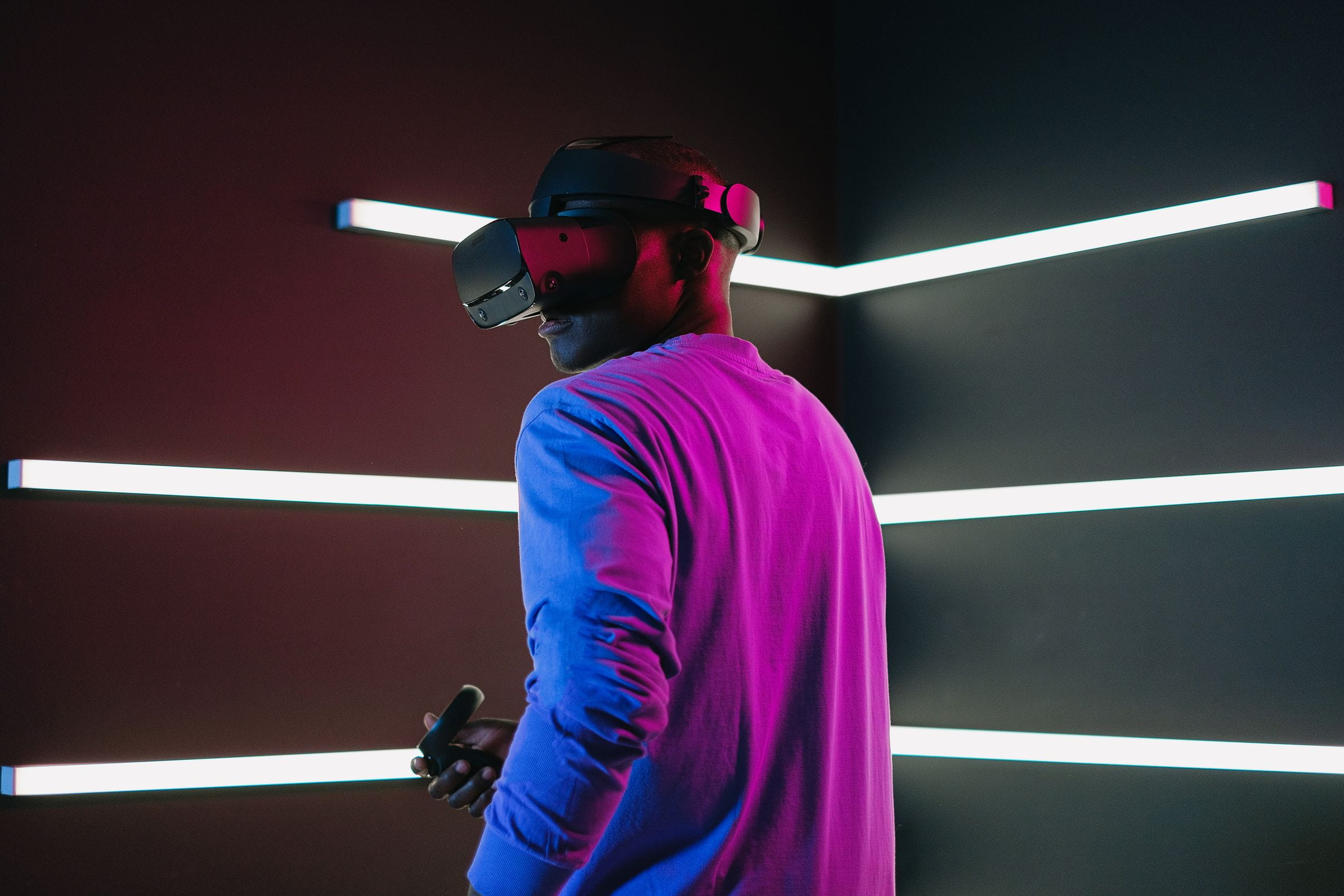
Immersive,
engineered for real use.
Augmented, virtual and mixed-reality applications for training, industrial, retail, healthcare and product visualisation, engineered for the physics of the device, not just the demo.
A complete immersive practice, engineered end to end.
From strategy through training, industrial AR, retail, healthcare, visualisation, WebXR, spatial computing, digital twins, content pipelines and deployment.
Immersive strategy & feasibility
Honest assessment of whether AR/VR is the right medium, grounded in the business problem, the users, the environments and the economics.
Training & simulation
Immersive training on Quest, Vision Pro, HoloLens and desktop VR, for safety-critical, high-skill and rare-scenario tasks where practice at scale is otherwise impossible.
Industrial AR & field service
Assisted workflows, remote experts, digital-twin overlays and inspection tools for engineering, manufacturing, energy and utilities.
Retail, commerce & try-on
3D product visualisation, virtual try-on, spatial commerce and configuration, engineered for the conversion metric that actually matters, not the launch tweet.
Healthcare & medical immersion
Surgical planning, rehabilitation, medical training and patient-education experiences, engineered with clinical rigour and regulatory posture appropriate to the setting.
Product & architecture visualisation
High-fidelity real-time visualisation for architecture, engineering and industrial products, where photoreal but interactive changes the decision-making.
WebXR & no-download immersive
Browser-based AR and 3D on WebXR, Three.js and Babylon.js, for reach without app-store friction, where the use case tolerates the constraints.
Spatial computing & Apple Vision Pro
Native Vision Pro and mixed-reality experiences, designed against the specific ergonomics, input model and social context of headworn devices.
Digital twins & simulation
Digital-twin overlays for factories, warehouses and infrastructure, with real-time telemetry, spatial context and operational integration.
3D content & production pipelines
Modelling, rigging, animation, LOD and optimisation pipelines, because most immersive projects live or die on content pipeline, not on runtime code.
Deployment & device management
Enterprise MDM, provisioning, kiosk mode and content distribution across Quest, Vision Pro, HoloLens and Android XR fleets.
Measurement & outcomes
Skill acquisition, task completion, error rate and business KPI measurement built in, so 'training in VR' is provable, not asserted.
Real users. Real hardware. Real environments.
A delivery model built for the honest realities of immersive, device ergonomics, content pipelines, measurement, and year-two operations designed from day one.
Frame
Business outcomes, users, environments and device constraints mapped honestly. Output: a phased plan where a pilot lands measurable value in weeks.
Prototype
A prototype in real hardware, with real users, in the actual environment, not a demo on a desk. Ergonomics, comfort, workflow and outcomes are stress-tested first.
Productionise
Full pipeline, content, code, integrations, distribution, measurement, engineered to the standard the deployment context requires (clinical, safety-critical or commercial).
Scale
Rollout, device management, content updates and outcome tracking treated as ongoing engineering, because the second-year cost of an immersive programme is where most quietly fail.
A pragmatic immersive toolchain.
Engine, device and pipeline choices are driven by the ergonomic, content and economic reality of the deployment.
 HoloLensAXAndroid XRWWebXRTThree.jsBBabylon.js
 React Three FiberAARKit
 ARCoreOOpenXRMRTKUUSDGglTFUUSDZ
 SwiftCC#CC++
 TypeScriptPPhotonMMirror
 AWSAzureGCP
Programmes delivered on this practice.



What prospective clients ask us first.
If your question isn't addressed here, please reach us at hello@tekansa.com.
01Is AR/VR actually the right medium for this?
Sometimes yes, often no. Immersive earns its place where spatial context, presence, muscle memory or scale can't be replicated on a screen, training for rare or dangerous events, product visualisation where fit and scale matter, industrial workflows with hands full, therapy and rehabilitation, education of complex 3D concepts. Where those conditions don't hold, a well-designed screen application usually wins on economics and adoption. We'll say so.
02Which headset, Vision Pro, Quest, HoloLens, or web?
Per use case, on evidence. Vision Pro for premium enterprise and prosumer spatial computing where the ergonomics and quality justify the cost. Quest for scaled training, education and consumer VR with strong economics. HoloLens 2 for industrial mixed reality where AR pass-through and enterprise stacks matter. WebXR where reach without app-store friction is worth the constraints. Most real programmes ship on more than one platform, and we're deliberate about the split.
03How do you make immersive training work at scale?
By treating it as a training programme, not a demo. Objectives, competencies and measurable outcomes are defined first; content and simulation are designed to match; measurement is instrumented so skill acquisition and error reduction are provable. Distribution, headset management, content updates and support are engineered from day one. The economics only work when the measurement matches the claim.
04How do you handle content and 3D pipelines?
Content pipeline usually determines project outcomes more than runtime code. We invest in USD/glTF-based pipelines, versioned assets, LOD strategies, occlusion, lightbaking and performance budgets from the start. Studios and engineering share the same pipeline, so revisions ship cleanly rather than fracturing the codebase. Most struggling immersive projects have a content-pipeline problem underneath, not an engineering one.
05How do you handle comfort, safety and accessibility?
Ergonomics, comfort, session length, cybersickness mitigation, seated versus standing, hand-tracking versus controller, colour-blind and dyslexia-friendly UX, designed in rather than tested at the end. For clinical or safety-critical contexts we align to the regulatory posture appropriate to the setting. Immersive experiences that ignore comfort don't get used twice.
06How do you handle deployment and long-term operations?
As real fleet operations. Enterprise MDM, provisioning profiles, kiosk configurations, content-update pipelines, support runbooks and lifecycle. Immersive programmes that don't take year-two operations seriously either stall or quietly die; we design that operating model into the engagement from day one.

Let's discuss your immersive programme.
Share a brief overview of the use case, users and target devices, we'll arrange an introductory conversation with the relevant practice leadership.