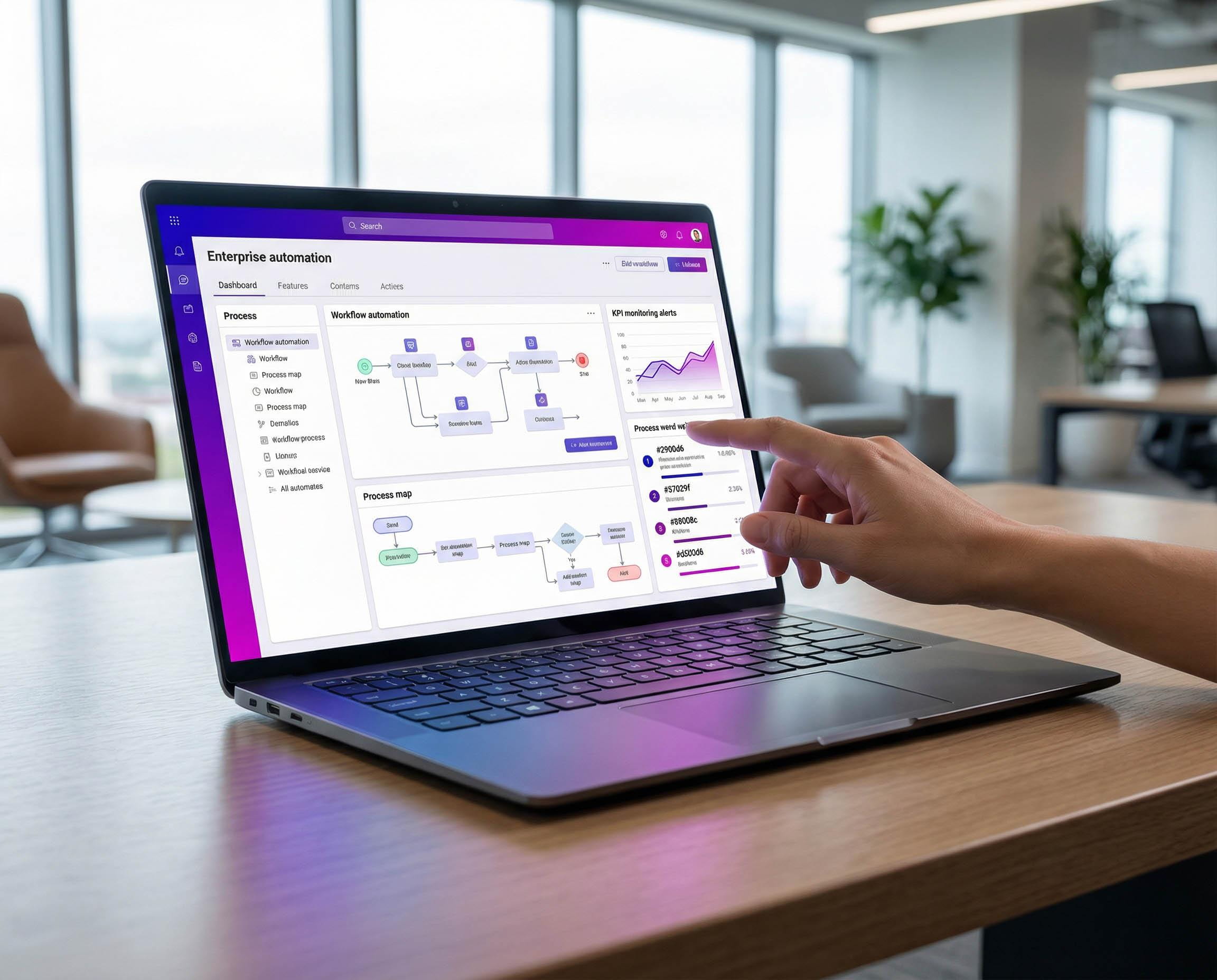
Business automation,
process to platform.
BPM, RPA, iPaaS, decision automation, intelligent document processing and agentic augmentation, designed to remove work, not to reshape it into a different kind of work.
A complete business-automation practice, engineered end to end.
From discovery and BPM through RPA, iPaaS, decision automation, IDP, agentic augmentation, case management, CoE and managed run.
Process discovery & mining
Task and process mining, honest triage of what warrants automation, and phased plans built on evidence, because half of most automation backlogs shouldn't be automated at all.
BPM & workflow orchestration
Long-running business processes on Camunda, Temporal and jBPM, with human tasks, timers, retries and audit engineered explicitly, not implied.
RPA & bot automation
UiPath, Automation Anywhere, Power Automate and Blue Prism bots, engineered with version control, environments, tests and CI, not managed as spreadsheets.
iPaaS & integration flows
Workato, Boomi, MuleSoft, Zapier and Make used where they earn their keep, with governance to stop the estate from turning into a shadow-IT hairball.
Decision automation & rules
Business rules on DMN, Drools, Camunda Decision and equivalents, with versioning, testing and lineage, so decisions are auditable rather than embedded in a bot's if-else tree.
Intelligent document processing
OCR, layout understanding and structured extraction from invoices, contracts, forms and correspondence, with validation, confidence thresholds and human review calibrated to risk.
Agent-augmented automation
Blends of deterministic automation with LLM reasoning, where 80% is boring and reliable, and reasoning is applied to the 20% that genuinely benefits from it.
Case management & customer ops
Case management platforms for service, ops and dispute workflows, engineered so agents, customers and systems share the same state and audit trail.
Citizen developer & no-code
Guardrails, templates and enablement so business teams can build safely, without generating the shadow-IT estate a platform team eventually has to clean up.
Automation CoE & governance
Intake, prioritisation, standards, environments, security and observability, so a 200-automation portfolio doesn't collapse under its own maintenance cost.
Value tracking & economics
Live value tracking that separates automations that pay back from ones that just moved the work, so the portfolio's economics stay defensible rather than aspirational.
Managed run & continuous improvement
Post-launch operations with SLAs, incident triage and continuous improvement, because automation that isn't operated becomes a Friday-night surprise.
Automate less. Automate better.
A delivery model built for the shape of automation work, honest triage of candidates, deterministic design and portfolio economics engineered from day one.
Discover
Process and task mining, evidence-based triage of candidates, and a phased plan. Not every process should be automated, that decision matters.
Design
Target design that favours APIs over UI, deterministic flow over prompts, and clear failure paths. Reusable components and standards are shaped before the first bot ships.
Deliver
Iterative delivery with version control, environments, tests and CI. Automations ship with monitoring, runbooks and rollback, like any production system.
Operate
Reliability, cost and business value monitored as ongoing engineering. Automations that stop paying back get retired instead of preserved.
A pragmatic automation toolchain.
Platform, orchestration and integration selection is a working decision, driven by your systems and economics, not by category preference.
 AirflowUUiPathAAAutomation AnywherePAPower AutomateBPBlue PrismWWorkatoBBoomiMMuleSoftZZapierMMakeNn8nDDMNDDroolsAABBYYRRossum
 AWS Textract
 Azure AI Doc IntelAAnthropicOOpenAI
 LangChain
 Python
 .NET
 Node.js
 Kafka
 Kubernetes
Programmes delivered on this practice.


What prospective clients ask us first.
If your question isn't addressed here, please reach us at hello@tekansa.com.
01How do you decide what to automate, and what not to?
By working from the process, not the tool. Volume, variance, stability and value tell us where automation pays back. Processes that are unstable, low volume or fundamentally require human judgement are usually the wrong candidates, automating them moves the pain rather than removing it. Most engagements produce a shorter target list than the one we started with.
02BPM, RPA or iPaaS, how do you choose?
A working decision per process. Orchestration engines (Camunda, Temporal) win for long-running workflows with human tasks, timers and idempotency. RPA earns its place where systems refuse to expose APIs. iPaaS wins for SaaS-to-SaaS glue at moderate volume. Custom services win where volume, latency or complex logic matter. The healthy portfolio uses a blend, chosen per process, not up-front as a religion.
03Where does agentic AI fit into business automation?
Where a process step genuinely needs planning, judgement or adaptation, customer conversations, triage of heterogenous cases, research-style tasks. Wrapped in deterministic flow, guardrails and human-in-the-loop where needed. We're deliberate about scope: adding an LLM to a stable rule-based step usually just makes the step slower, more expensive and less reliable.
04How do you run a healthy automation programme at scale?
As a centre-of-excellence with intake, prioritisation, reusable components, standards, environments, security and observability. We keep a live portfolio view of every automation's value, cost and reliability, so the ones that stop paying back get retired. The economics of a 200-bot estate are made or broken here.
05How do you keep the business team engaged without becoming shadow-IT?
By giving business teams a paved road, templated apps, sanctioned platforms, guardrails and shared components, so building is safe by default. Where they need custom capability, we onboard it into the same governance model rather than leaving it in a spreadsheet. Citizen development becomes a multiplier when the platform team meets it halfway, and a liability when it doesn't.
06How do you handle security, compliance and audit?
Credentials in vaults, least-privilege access, segregation of duties, change control and full audit trails, from day one. Automations are treated as identities with owners, permissions and lifecycle. We align to SOX, ISO 27001, GDPR and sector-specific regimes where they apply, and produce evidence alongside delivery rather than before audit.

Let's discuss your automation programme.
Share a brief overview of the processes you're trying to automate, we'll arrange an introductory conversation with the relevant practice leadership.