APIs,
shipped as product.
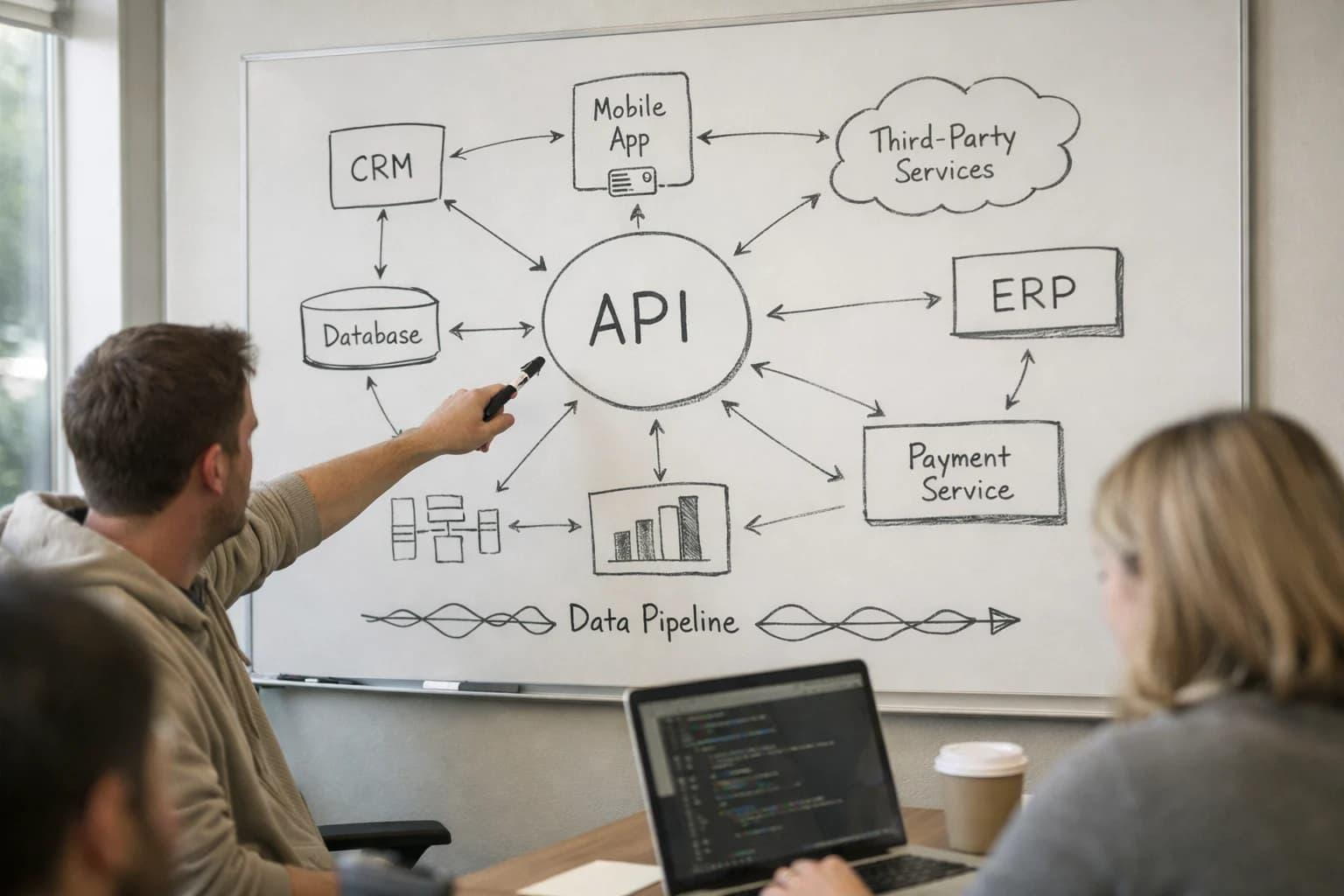
REST, GraphQL, gRPC, events and iPaaS engineered as first-class product surfaces, with contracts, versioning, security, developer experience and observability designed to survive change.
A complete API practice, engineered end to end.
From strategy and design through gateways, events, iPaaS, B2B, DX, security, observability and legacy exposure, our practice covers the full delivery surface of enterprise integration.
API strategy & architecture
Enterprise API strategy, domain decomposition and reference patterns, grounded in the systems and consumers you actually have, not lifted from a reference architecture.
API design & contracts
REST, GraphQL and gRPC design done properly, with contracts, examples and versioning treated as first-class, so consumers can integrate without reverse-engineering.
API gateway & management
Kong, Apigee, AWS API Gateway, Azure APIM and Gravitee stacks, with rate limits, auth, quotas and analytics engineered against real traffic patterns.
Event-driven & streaming
Kafka, Kinesis, EventBridge and NATS event backbones, with schemas, ordering and idempotency modelled explicitly so consumers can rely on them.
iPaaS & integration platforms
MuleSoft, Boomi, Workato, Azure Integration Services and n8n, used where they earn their keep, and skipped where a boring service wins.
B2B & partner integration
EDI, AS2, SFTP, partner portals and modern B2B APIs, with onboarding, monitoring and disputed-transaction paths engineered from day one.
API security & governance
OAuth2/OIDC, mTLS, JWT, scopes, secrets, DLP and threat protection aligned to OWASP API Top 10 and sector-specific regimes.
Developer experience & portals
API portals, docs, sandboxes, SDKs and versioning, designed so an integrator ships to production without needing an implementation manager.
Observability & analytics
Traces, latency, error and consumer-level analytics, because knowing which consumer is breaking which endpoint is what turns APIs into a real product.
API productisation & monetisation
Plans, quotas, billing and usage-based monetisation for internal, partner and public APIs, engineered for teams that actually want their APIs used.
Legacy exposure & modernisation
Wrapping legacy systems with modern APIs, with contracts, backpressure and clear seams, as a foundation for later replacement rather than as the end state.
Managed API operations
Post-launch operations, SLAs, deprecation, consumer support, security review and continuous improvement, treated as an engineering discipline.
Contracts first. Consumers second. Systems third.
A delivery model that treats APIs as products, designed from real consumer needs, shipped with tests, DX and monitoring, and operated as an ongoing discipline.
Frame
Domain map, consumers, contracts, existing estate and pain points mapped. Output: a phased plan with a first slice a real consumer will actually use.
Design
Contracts, patterns, gateway, security and DX designed together, because a well-designed API stack is a product, not an afterthought of the backend team.
Deliver
Iterative delivery with contract tests, mocks, sandboxes and versioning. Consumers ship earlier because the surface is honest earlier.
Operate
Adoption, latency, security and deprecation monitored as ongoing engineering. The API estate compounds instead of accumulating debt.
A pragmatic integration toolchain.
Gateway, iPaaS and framework choice is driven by traffic, ownership and economics, not by whichever platform is in the current strategic partnership.
 GraphQLGgRPCOOpenAPIAAsyncAPIKKongAApigee
 AWS API Gateway
 Azure APIMGGravitee
 KafkaKinesisEventBridgeNNATSRRabbitMQMMuleSoftBBoomiWWorkatoNn8nAzure Integration Services
 Auth0OOkta
 PostmanSStoplight
 Node.js
 .NET
 Java
 Python
 Go
Programmes delivered on this practice.



What prospective clients ask us first.
If your question isn't addressed here, please reach us at hello@tekansa.com.
01REST, GraphQL or gRPC, how do you choose?
Per surface, on evidence. REST wins where broad reach, HTTP semantics and caching matter, most public and partner APIs sit here. GraphQL earns its place where consumers pick fields from a rich domain (typically internal or product back-ends). gRPC is right where latency, streaming and typed contracts between services matter most (internal service-to-service). Most real estates use two or three of them, and we're clear about which lives where.
02How do you handle API versioning without breaking consumers?
By treating contracts as first-class. Non-breaking additions are safe; breaking changes require an explicit new version with a defined deprecation window, migration guidance and monitoring on the old version. We prefer schema-based evolution over URL-based version proliferation, and we treat 'a consumer we didn't know about' as an operational bug in observability, not as their problem.
03iPaaS or hand-rolled integrations, how do you decide?
Per integration, on volume, latency, cost and complexity. iPaaS wins for SaaS-to-SaaS glue at moderate volume, low-code changes and non-critical paths. Custom services win where volume, latency, complex transformations or reliability matter, or where the licence tail of iPaaS becomes uneconomical. Most real estates use both, and we're deliberate about where the line lives.
04How do you approach API security beyond just OAuth?
Threat model per API. OAuth2/OIDC or mTLS for auth; scopes for authorisation; rate limits and quotas for abuse; input validation and schema enforcement; DLP and encryption for data in transit and at rest; and continuous security testing aligned to the OWASP API Top 10. Public APIs get red-teamed. Nothing goes live without a threat model matched to actual blast radius.
05How do you make developer experience of APIs actually work?
Portals with searchable docs; contract-driven examples; sandboxes with realistic data; SDKs where they earn their keep; sample apps; and clear versioning and deprecation policies. The measurable outcome is: an integrator lands their first successful call without calling us. Most API estates fail on DX rather than on capability, and DX is engineering work, not documentation homework.
06How do you handle observability and consumer-level analytics?
Distributed tracing end-to-end; per-consumer, per-endpoint latency, error and payload metrics; anomaly detection on traffic patterns; and business analytics on adoption and value. Knowing which consumer is hitting which endpoint at what rate is what turns an API estate from cost centre into a real product surface, and it's what makes deprecation possible without breaking consumers you'd forgotten.

Let's discuss your API programme.
Share a brief overview of the surfaces and consumers, we'll arrange an introductory conversation with the relevant practice leadership.